Chris Hall
Personal Trainer and Founder of Hall Personal Training
Exercise Nutrition Wellness
September 9, 2017
From debunking the myth behind BCAA supplementation on muscle growth, to foam rolling and shirt splitting arm science, August’s fitness research has covered it all. Our level 5 trainer Owen has sifted through it all to bring you some gems you can apply to your own training straight away – enjoy!
1. Branched-chain amino acids and muscle protein synthesis in humans: myth or reality?
If you’ve ever had a peek inside a sports nutrition shop, scrolled through a few health websites or simply seen one of the tens of thousand “ADD GENERICFITPROCOMPANY to get your X,Y,Z” on instagram, you’re more than likely familiar with the supplement BCAAs.
If you’re not, congratulations, you’ve probably saved yourself some cash.
Despite commonly held beliefs that these Branched Chain Amino Acids promote anabolism (the growth of tissue) and stave off catabolism (the breakdown of tissue), a recent review by Robert Wolfe (2017) suggests otherwise.
I’ll save you the in depth biochemical details (which are all examined here), and skip to the punch line.
In order to achieve sufficient MPS (muscle protein synthesis) to grow muscle tissue, all EAA (the 9 essential amino acids) are required. This means that the three isolated EAA’s found in BCAAs fall short of the ability to stimulate MPS to the extent of anabolism.
Further to this, the paper theorizes that due to the competition of leucine, iso-leucine and valine for transporters to the cell, MPS may actually be rate-limited by their co-ingestion. This explains why leucine in isolation has been shown to have positive effects on MPS, whilst BCAA’s tend to skew negatively.
Now if you managed to make it through all of those many acronyms, the important take homes are these:
BCAAs do not promote MPS in isolation, all of the amino acids that the body cannot produce are needed. Not only that, but due to the competition of transportation, BCAAs may actually limit MPS, and blunt anabolism.
All in all, this is perhaps the most damning review of BCAAs to date. The kind of stuff that sends a cold chill down the neck of supplement companies everywhere.
My advice?
Whey protein is cheaper, has a full amino acid profile, and has been shown to increase MPS in a peri-workout window.
When total protein is accounted for, there is no coherent reason to be using BCAAs.
Unless of course, you happen to like the taste of particularly expensive flavoured water.
2. The Real Secret to Shirt Splitting Arms (Click Bait Alert)
If you’ve ever meandered into the free weights section of the gym on a Friday night, you’ll be fully aware of the vast quantity of males gathering around the Preacher Curl machine.
Come 6:30pm, not a single EZ Bar nor 10kg dumbbell will be free for use. Not unlike a holy ritual, the clubbers and pubbers of the city amass to pay their respects to the iron.
As far as I’m aware, the practice of training biceps on a Friday evening has been around for as long as the working week has.
Yet when it comes to mastering the art of crafting biceps that render sleeves useless, should we be using heavier loads, or focusing on precise execution?
A recent study, freshly published in the Journal of Strength and Conditioning, sought to provide us with some clarity, comparing two groups using full ROM (range of motion) and partial ROM using 80% 1RM on unilateral elbow flexion on the Scott Bench.
Despite the peak torque, soreness from palpation and arm circumference being statistically similar between conditions, more expressive muscle damage was found in the full ROM (range of motion) group.
As muscle damage is a key pathway towards increasing hypertrophy in a given muscle, we can extrapolate from this study that full ROM exercises are more beneficial than partials for promoting tissue growth, despite the greater absolute load lifted under the partial ROM circumstances.
So if you ever find yourself in that 6:30pm Friday crowd, opt for tighter execution, and eek out as much ROM as you comfortably can.
You’ll be splitting shirts in no time.
Bonus tip:- Pre-shrink your shirt sleeves in the wash. It’s a thing. Unfortunately.
3. Leg Day, Is foam rolling worth our time?
If you’re a regular reader of our blog spot, you may have noticed that our main maestro Chris Hall recently dove into the depths of foam rolling, discussing what it actually does, the benefits and the potential pitfalls.
While I won’t be following Chris down that frightfully deep rabbit hole today, generally speaking the practice of SMR (self-myofascial release) can acutely increase flexibility and aid blood flow to the targeted area, making it a good option before partaking in physical activity.
Not only that, but foam rolling seems to trend towards a ‘cross-over flexibility’ effect, meaning that if you foam roll one area, a corresponding area may actually become more flexible. For instance, rolling out the bottom of the foot with a tennis ball may improve hamstring flexibility.
However, an interesting study published this month by Cavanaugh M.T (2017) found that this isn’t the case in all muscle groups.
The research team found that when SMR was performed on the quadricep muscles, subsequent activation of the bicep femoris (hamstring) decreased significantly. There was no such change in the quadriceps when the hamstrings were rolled.
What does this mean?
Although this is just one study out of many, and no firm conclusions can be drawn yet, it might be an idea to leave the quadriceps out of your next foam rolling routine, particularly if you have a hamstring-biased session.
I also do this because my quads always hurt so much I want to cry.
So much pain, many ouches.
4. The low down on low load training, can you still build muscle?
As personal trainers, I think it’s safe to say that we’re pretty obsessed with adding weight to the bar. In order to disrupt homeostasis and adapt our bodies, increasing levels of stimulus need to be accounted for over a long period of time.
Progressively loading more weight onto a bar continuously allows for appropriate stimulus of which to adapt, building larger, stronger muscles.
Yet while progressive overload is an incredibly (if not the most) important aspect of hypertrophy, is it possible to build muscle using lower relative loads?
There have actually been several studies that have previously shown this could be the case, yet no clear review to pool this data and come up with a conclusive answer.
Enter Schoenfeld B.J. et al. (2017)
This much needed systematic review observed data from 21 of available studies that met the requirement of:
– Using both >60% 1rm and <60%1rm loads.
– All sets in all training protocols reaching momentary muscular failure.
– At least one method of estimated/observing changes in muscle mass and/or dynamic, isometric or isokinetic strength.
– The training protocol lasted a minimum of 6 weeks
– No participants had pre-existing medical conditions that would disrupt potential results.
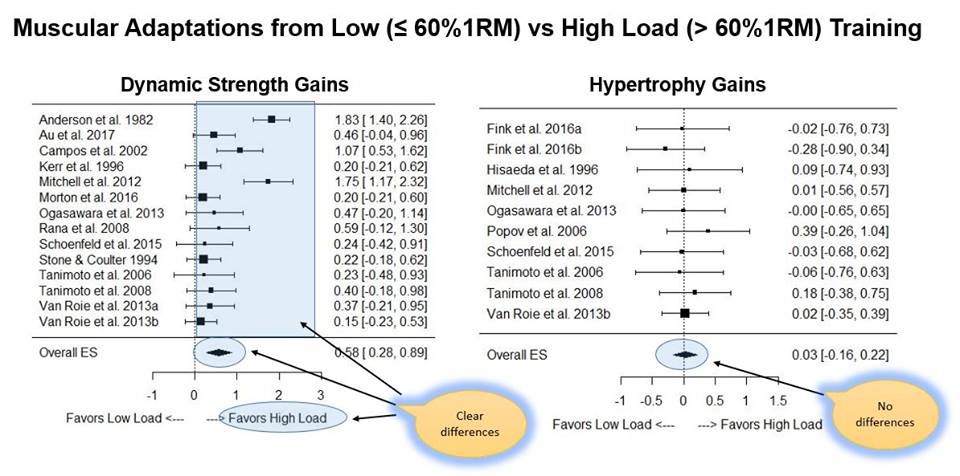
(image: Schoenfeld, B.J et, al. (2017). Strength and hypertrophy adaptations between low- versus high-load resistance training)
Interestingly enough, the data pool suggests that while it’s fundamentally clear that heavier loads are needed in order to increase strength gains, it’s entirely possible to create muscular hypertrophy adaptations in circumstances of low load training.
If we take a look at the above chart, all markers that fall to the right of the centre line, show that heavier loads hold a clear advantage, while everything falling to the left demonstrate low loads being advantageous.
The bottom line?
It’s entirely possible to build muscle whilst using loads lower than 60% of your 1rm. It’s easy to attach the principle of ‘progressive overload’ to simply adding more weight to the bar, while in reality there are many forms of the mechanism.
Decreasing rest times, increased frequency, increased volume, increasing time under tension, greater internal connections to contractions, velocity, loading through different ranges of motion, mechanical drop sets.
The list could go on.
The concept of ‘progressive overload’ in reality, is the ability to bring about increasing levels of stimulus of which to adapt. Do this over a long period of time, and you’ll be putting yourself in a good position to progress, extra load isn’t the only variable we can manipulate.
Oh, and if you want to get stronger, lift heavier.
5. Want to decrease your x-country time? Check this study out.
Coincidentally, prior to writing up this study I stumbled upon all of my old x-country medals/trophies/certificates/other causes of inflammatory hubris.
Turns out, I was quite the little runner in high school, unleashing those pale, peg-like legs and representing South Wales on the odd occasion.
As coincidence (or fate) would have it, an incredibly relevant study was accepted and published by the Journal of Strength & Conditioning research this August, examining high school x-country runners.
Naturally, my curiosity prevailed and I had to take a peek at the findings. After all, this new information might have been the missing link in my progression!
It’s theorised that a key reason for a decrease in running efficiency and therefore running economy is due to the fatigue of the muscles that stabilise the movement.
This study examined whether a protocol in pelvic and core stability strength training had any beneficial relevance to high school x-country runners across a six-week period.
Race times were measured at three and six week intervals, and interestingly enough, both the control group and the pelvic protocol group saw decreases in their race times.
What does this tell us?
Core stability work might help, or it might not. I know, great stuff.
We can however, further ascertain that the primary method to get better at running, is to run more. Time on your running feet is the primary mechanism to build greater running efficiency and economy, thereby decreasing your race time.
Run more, get better.
Looks like I was never destined for greatness, and didn’t miss a trick in my running days after all.
I’m not sure if that’s a comfort or not.
Anyhow, if your preparing for a marathon and still have some thrist left for knowledge, then you gather a few more helpful tips from a blog we contributed to for Ashbounre Health, check it out here.
References
1. Robert R. Wolfe. (2017). Branched-chain amino acids and muscle protein synthesis in humans: myth or reality?. Journal of the International Society of Sports Nutrition
2. Baroni, Bruno et al. (2017). Full Range of Motion Induces Greater Muscle Damage Than Partial Range of Motion in Elbow Flexion Exercise With Free Weights. Journal of Strength & Conditioning Research:. 31, 2223-2230.
3. Cavanaugh, Mark T et al. (2017). Foam Rolling of Quadriceps Decreases Biceps Femoris Activation. Journal of Strength & Conditioning Research:. 31 (.), 2238-2245.
4. Schoenfeld, Brad & Grgic, Jozo & Ogborn, Daniel & Krieger, James. (2017). Strength and hypertrophy adaptations between low- versus high-load resistance training: A systematic review and meta-analysis. Journal of strength and conditioning research. 10.1519/JSC.0000000000002200.
5 .Clark, Anne W et al. (2017). Effects of Pelvic and Core Strength Training on High School Cross-Country Race Times. Journal of Strength & Conditioning Research. 31 (.), 2289-2295

Chris Hall
Personal Trainer and Founder of Hall Personal Training
you may also enjoy...

How Many Hours Per Week Should You Exercise? The Science-Backed Answer
We break down exactly how to split your time between strength and cardio for maximum health, longevity, and results.

Why Most People Never Start Exercising (Even When They Really Want To)

How Many Steps Should I Actually Walk a Day?

Why Women Should Cold Plunge – and the Benefits You’ll See
is cold exposure safe for women?

Vitamin D in Winter: Why Your Levels Drop and How to Optimise
beyond just sun and supplements