



Stop Aiming for 10,000 Steps: Here Is Your Ideal Daily Step Target (backed by science)
With the rise in popularity of fitness trackers and wearables such as Garmin, Fitbit, and smart rings, we are becoming much more aware of our health and daily movement patterns. Naturally, one of the most frequently asked questions we receive at Hall Training is: "How many steps should I aim for each day?"
Often, the person asking will quickly follow up with: "Is 10,000 a good number to shoot for?" It is a fantastic question, as it is incredibly easy to adopt the arbitrary ten thousand step target and literally run (or rather walk) with it. Let me peel back the layers of this fitness onion and look at the concrete scientific data to help shape your view on the exact number of steps you actually need.
The Myth of the 10,000 Step Target
A short trip through history reveals that the 10,000-step target was never based on scientific research or recommended by health experts. It was actually born from a highly successful Japanese public relations and marketing campaign leading up to the 1964 Tokyo Olympics.
Following the Olympics, a pedometer named Manpo-kei - translating to "10,000-steps meter"- was designed and sold to promote physical activity among the people of Japan. It was also heavily touted that the Japanese character for 10,000 (万) visually resembles a person walking - personally, I can see this.
Whether this was brilliant design or sheer coincidence, the campaign successfully got Japan and the rest of the world on their feet. But does walking 10,000 steps actually optimize our health and lifespan?
The Science of Step Counts and Diminishing Returns
The answer depends entirely on your current baseline level of fitness. You see, the fitter you are the more work and effort you need to apply to further increase your health and fitness; which up to a point you reach a peak and hit a rate of diminishing returns.
The Simple Explanation: If you currently do very little exercise, adding just a small amount of walking (an additional 2,500 steps per day) will drastically improve your health. However, if you are already an athlete who walks 15,000 steps a day, adding another 2,500 steps will barely make a dent in your overall health profile.
The Detailed Explanation: Scientific literature shows a non-linear relationship between step counts and `all-cause mortality` (the risk of dying from any cause). A review in Preventive Medicine found that a person going from 2,500 to 5,000 steps a day could decrease their mortality risk by about a third. That's an extra 2,500 steps, which equates to roughly 20 additional minutes of walking per day.
Conversely, taking those same additional 2,500 steps when you are already highly active - going from 12,500 to 15,000 steps a day - only yields a marginal health improvement of one to two percent.
Finding Your Ideal Step Target
To help you determine exactly what you should be aiming for, I've have broken down the scientific data based on your current activity levels. Sadly, the average UK adult only gets between 3,000 and 5,951 steps per day. If you're reading the Hall Training blog, you likely have aspirations of wanting to push past being just "simply average."
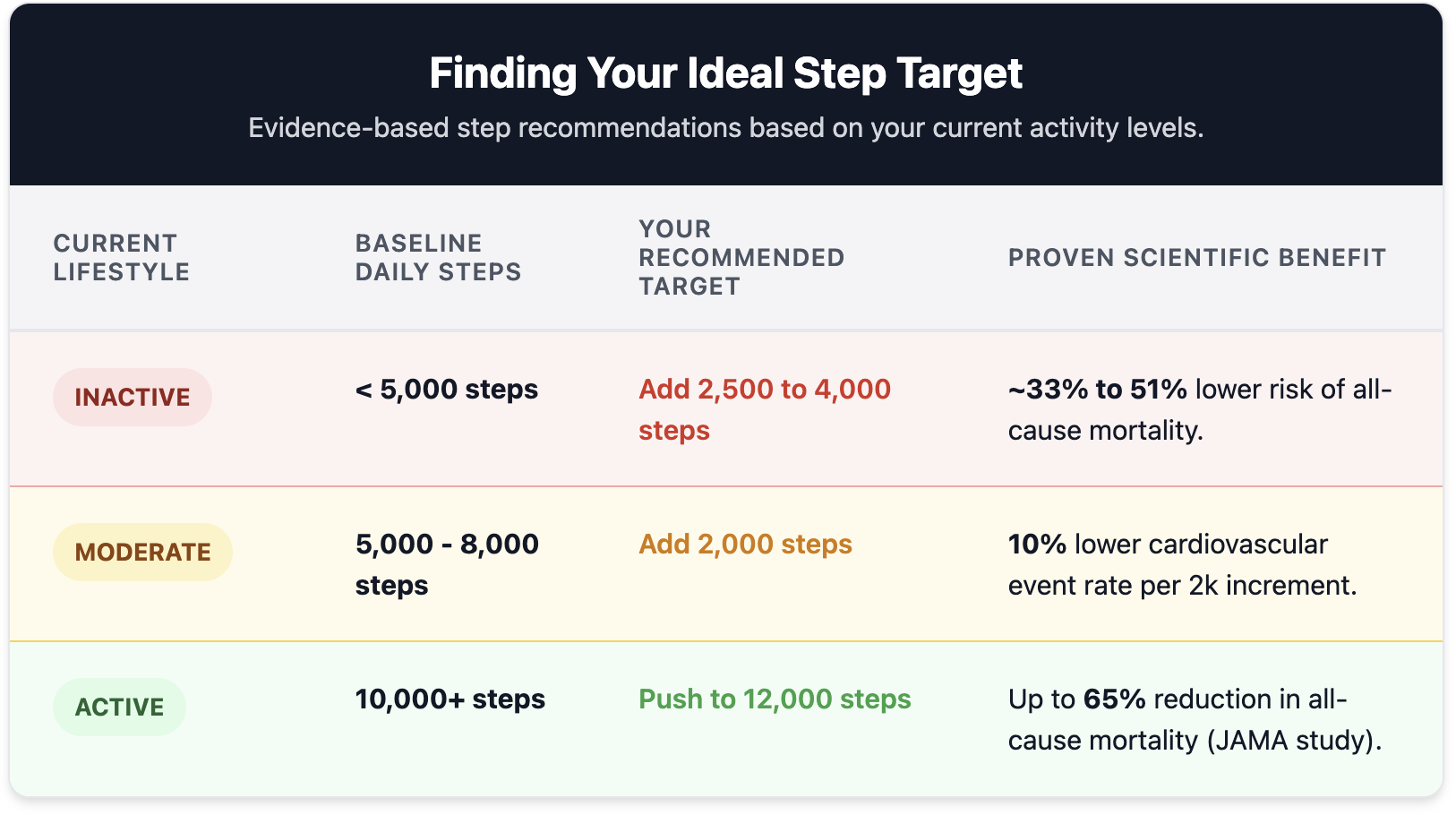
If you lead an inactive lifestyle (<5,000 steps per day), then you have two possible options:
- Shoot for an additional daily step increase of 2,500 steps – this will reduce your risk of dying by around a third.
- Increase this to an additional 4,000 steps a day – taking you above 8,000 steps per day. You'll soon see the benefits observed in the JAMA study, where participants saw a 51% reduced risk of dying from any caus
For those in the middle - mildly active (5,000-8,000 steps):
- A 2019 review of seven different studies found that every increment of 2,000 steps per day (up to 10,000) was associated with a 10% lower cardiovascular event rate.
- Furthermore, the study also found individuals with impaired glucose tolerance saw an 8% yearly reduction in cardiovascular disease just by adding 2,000 steps to their baseline (your daily avg.)
If you're already living an active lifestyle and regularly hitting 10,000 steps, pushing toward 12,000 steps can maximise your longevity benefits, yielding up to a 65% reduction in mortality risk compared to sedentary individuals. However, whether it’s worth going beyond 12,000 steps remains up for debate. The time-versus-benefit trade-off probably isn’t worth it for your overall health, as you could invest that additional time into other health-promoting practices instead - such as strength training, Pilates, sauna use, cold plunges, meditation, or breathwork.
The Power of Walking in Nature
Where you walk can be just as important as how much you walk. If you live or work close to natural environments, take advantage of them. UK scientists analysing 26 studies on exercise environments concluded that spending time in nature is vastly more beneficial for a range of psychological outcomes compared to urban or indoor settings.
Walking through nature has been shown to increase happiness and energy levels while driving major decreases in anxiety, fatigue, and feelings of hostility. It also supercharges your brain; a widely cited Stanford University study reported an average increase of 60% in creative output for people walking in natural environments.
Final Thoughts: Time to Level Up
If you're ready to observe dramatic changes in your fitness, energy levels, creativity, mood, and health, there is no magic pill that compares to the power of walking. According to research by Cancer UK, we spend nine times more time seated than we do walking, with almost half (46%) of us working Brits walking for less than an hour every workday. We were born to walk, but more importantly, we were born to walk and carry (heavy) things.
Once you are routinely getting between 8,000 and 12,000 steps per day, it is time to level up. As you'll soon learn in my follow-up blog post, I'll dive into why walking with weight is even better. Grab a pack, load some weight, and let's carry the load!
Until next time - get outside, get walking!
Summary of Key Points
- The 10k Myth: The 10,000 step rule was a 1964 marketing stunt (Manpo-kei), not a medical directive.
- Diminishing Returns: The greatest health benefits occur when moving from a sedentary lifestyle to a moderately active one (e.g. jumping from 2,500 to 5,000 steps drops mortality risk by 33%).
- Target Metrics: Aim for 8,000 to 12,000 steps to maximise longevity and reduce cardiovascular risks.
- Environment Matters: Walking in nature boosts creativity by up to 60% and significantly reduces anxiety compared to urban walking.
- Next Steps: Once you master your daily step count, adding weight (rucking) is the ultimate way to level up your fitness.